


![[Free Monitor] Wattcycle 48V 105Ah Golf Cart Bluetooth LiFePO₄ Lithium Battery – 250A BMS for High Torque & Hills](http://www.wattcycle.com/cdn/shop/files/WT48V105AH250GCBT_fd49751b-10f0-467d-9543-afe48c8b6ec4_300x.webp?v=1777023011)
![[Free Monitor] 48V 100Ah Golf Cart Bluetooth LiFePO₄ Lithium Battery - 200A BMS](http://www.wattcycle.com/cdn/shop/files/WT48V100AH200GC_300x.webp?v=1777023011)


![[Free Monitor] Wattcycle 48V 105Ah Golf Cart Bluetooth LiFePO₄ Lithium Battery – 250A BMS for High Torque & Hills](http://www.wattcycle.com/cdn/shop/files/WT48V105AH250GCBT_fd49751b-10f0-467d-9543-afe48c8b6ec4.webp?v=1777023011&width=320)
![[Free Monitor] 48V 100Ah Golf Cart Bluetooth LiFePO₄ Lithium Battery - 200A BMS](http://www.wattcycle.com/cdn/shop/files/WT48V100AH200GC.webp?v=1777023011&width=320)


The 48V LiFePO4 battery can plug straight into an EcoFlow Wave 3 direct through WattLINK cable, no adapter or workaround needed. Since the Wave 2 and Wave 3 look nearly identical from the outside, the same rooftop form factor and the same series, as well as the same XT150 port. It's an easy assumption that the same solution over here too. However, the result might be different from what you expected, and the answer turns out to be more interesting than a flat yes or no.
Why Do Wave 2 Owners Look for a Way to Add a Bigger Battery?
The Wave 2 has no internal battery of its own. Every session of cooling or heating draws from an external source, either EcoFlow's own Add-on Battery or a compatible Delta power station, which means runtime has always been a direct function of whatever's plugged into that XT150 port. For anyone using the Wave 2 through a full day of camping or an extended stretch in an RV, that dependency naturally leads to the same question WattLINK answers for the Wave 3: can a larger, more affordable third-party battery take that job over? For an EcoFlow Wave 2 battery connection specifically, the honest answer needs a bit more explanation than it does for its newer sibling.
Why Won't a 48V LiFePO4 Battery Connect Directly to the Wave 2's XT150 Port?
The Wave 2's XT150 port runs a closed CAN-bus communication handshake before it allows any real power through. WattLINK cable identification signal, the one that satisfies the Wave 3 and both Delta 2 and Delta 3 units by presenting itself as a legitimate power source, doesn't pass that stricter check on the Wave 2. This isn't a wiring or voltage mismatch. The EcoFlow Wave 48V system on the Wave 2 side is looking for a specific verified handshake, and a direct third-party connection simply doesn't speak that language.
What Happens if You Plug an Unrecognized Battery Into the Wave 2 Anyway?
Nothing catastrophic, but nothing useful either. Without a verified power source behind it, the Wave 2 won't enable full DC output, at best it drops into fan-only mode, with the compressor locked out entirely. It's worth putting that in context against the unit's own official Add-on Battery, which holds 1159Wh rated for roughly 800 cycles before dropping to 80% capacity. That's the "authorized path" the Wave 2 is actually checking for behind the scenes, and it's also the ceiling a lot of owners are trying to get past.
So, What's the Actual Trick to Making This Work?
The trick isn't finding a way around the Wave 2's authentication check. It's routing power through a device the Wave 2 already trusts completely. Here's the full guide video, from YouTube content creator @theresatrickforthat. Before you take it upon yourself to scale up your wave 2, watch the full DIY guide video.
How Does a Delta 2 or Delta 3 Solve This Authentication Problem?
A Delta 2 or Delta 3 already has a legitimate, factory-recognized handshake with the Wave 2 through EcoFlow's own connection cable, since that pairing was built into the ecosystem from the start. Separately, a WattLINK XT150 cable connects a third-party 48V LiFePO4 battery into that same Delta unit's own expansion battery port, a connection the Delta accepts without issue. Put those two legitimate connections together, and the Delta station ends up doing double duty: regulating voltage and handling the protocol handshake on the Wave 2's behalf, without either device ever seeing an unauthenticated source.
What Does the Full Connection Path Look Like?
Laid out plainly, the path runs: a 48V LiFePO4 battery, connected through WattLINK, into a Delta 2 or Delta 3, connected through EcoFlow's own XT150 cable, into the Wave 2. Each link in that chain is a connection the receiving device already recognizes as valid, which is exactly why the setup works even though a direct battery-to-Wave-2 connection doesn't. It does mean owning, or adding, a compatible Delta unit as part of the setup, this isn't a Wave 2-only accessory purchase.
Which Battery Is the Best Fit for This Setup?
For most Wave 2 owners running this off a camping trip or an RV, the WattCycle 48V 50Ah battery is the practical starting point. At 44 lbs and sized at 10.4 x 7.2 x 13.02 inches, it's light and compact enough to move in and out of a vehicle without needing a dedicated mounting setup, which matters a good deal more for a portable air conditioner used on the move than it does for a stationary home battery bank.
On the numbers, it delivers 2,560Wh at 51.2V nominal voltage, more than double the capacity of EcoFlow's own Add-on Battery, and supports 2C continuous discharge with a built-in 100A BMS rated for peak surges up to 150A for 30s or 300A for half a second, well beyond anything a Wave 2's startup draw will ever ask of it. The IP54-rated metal shell and 6000 plus deep cycle rating at 80% depth of discharge make it a reasonable fit for repeated outdoor use rather than a single-season purchase, and a top-mounted physical power switch lets you fully disconnect it during storage to avoid slow drain between trips. As a 48V 50Ah lithium battery kit, the bundle runs $499.99 and includes the WattLINK cable itself. Use discount code BLOGEXTRA at checkout to get 6% off your order, after the coupon code only $469.99.
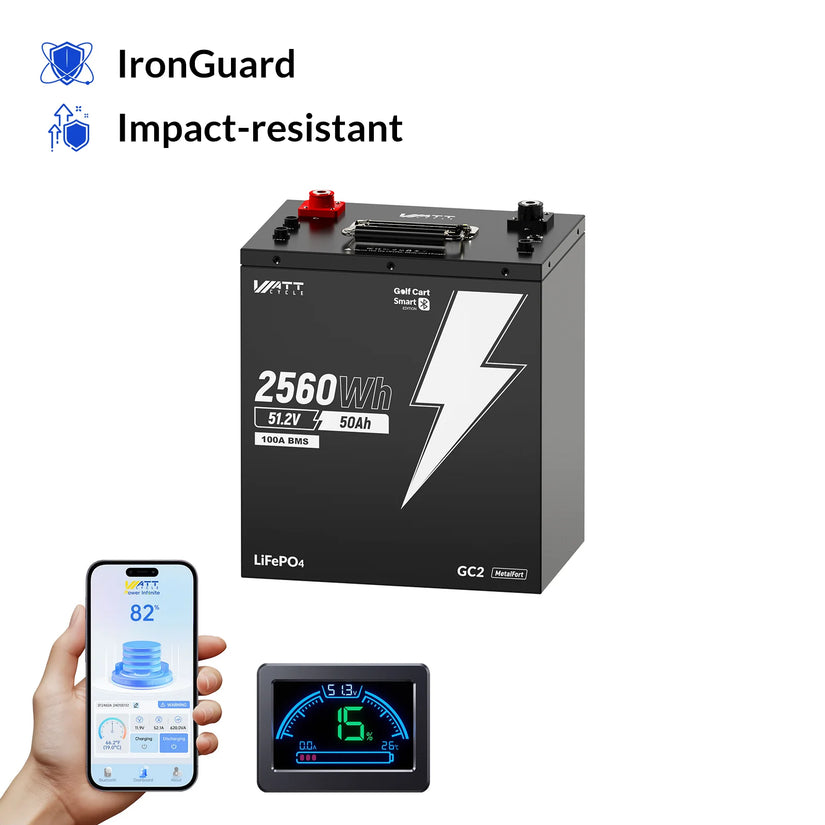
WattCycle 48V 50Ah GC2 Lithium Battery
For anyone who wants meaningfully more capacity than that, the same WattLINK cable also pairs with WattCycle 48V 100Ah server rack battery, the unit some reviewers have used to stretch a Wave 2 toward a full day of nonstop runtime. It's a heavier, bulkier option built more for a fixed installation than a grab-and-go trip, which is exactly why it makes sense as the upgrade path rather than the default recommendation for most Wave 2 owners.
What Should You Check Before Setting This Up?
A few things are worth confirming before ordering anything:
- Your Delta model actually supports Wave 2 pairing. Not every EcoFlow power station in the lineup does, so confirm this against your specific Delta 2 or Delta 3 model.
- WattLINK fits that specific Delta model's port. Cable compatibility is tied to the Delta unit, not just the battery.
- State of charge is roughly matched before connecting. Linking a fully charged 48V 50Ah energy storage LiFePO4 battery to a near-empty Delta unit isn't the ideal way to start a connection.
- You're not attempting a direct Wave 2 connection. Skipping the Delta bridge and wiring a battery straight into the Wave 2's port won't work, regardless of how the cable is configured.
Learn More About Connecting a 48V Battery to Your EcoFlow Setup
If a Wave 3 is also part of your setup, or you're deciding between the two units, WattCycle's guide on how to affordably add battery capacity to the EcoFlow Wave 3, covers the simpler, direct connection process that applies there. Or read the guide about WattLINK cable directly with Delta 2/3 Portable power station.
How to Expand Your EcoFlow Delta 2 Capacity Without Buying an Official Add-On?
EcoFlow Expansion Battery vs. Third-Party: Which One Is Actually Worth It?
Is It Safe to Connect WattCycle Battery to EcoFlow Using a WattLINK Expansion Cable?


Comments
No comments yet. Be the first to share your thoughts.
Leave a Comment