


![[Free Monitor] Wattcycle 48V 105Ah Golf Cart Bluetooth LiFePO₄ Lithium Battery – 250A BMS for High Torque & Hills](http://www.wattcycle.com/cdn/shop/files/WT48V105AH250GCBT_fd49751b-10f0-467d-9543-afe48c8b6ec4_300x.webp?v=1777023011)
![[Free Monitor] 48V 100Ah Golf Cart Bluetooth LiFePO₄ Lithium Battery - 200A BMS](http://www.wattcycle.com/cdn/shop/files/WT48V100AH200GC_300x.webp?v=1777023011)


![[Free Monitor] Wattcycle 48V 105Ah Golf Cart Bluetooth LiFePO₄ Lithium Battery – 250A BMS for High Torque & Hills](http://www.wattcycle.com/cdn/shop/files/WT48V105AH250GCBT_fd49751b-10f0-467d-9543-afe48c8b6ec4.webp?v=1777023011&width=320)
![[Free Monitor] 48V 100Ah Golf Cart Bluetooth LiFePO₄ Lithium Battery - 200A BMS](http://www.wattcycle.com/cdn/shop/files/WT48V100AH200GC.webp?v=1777023011&width=320)


You've probably seen the range of battery options for 48V golf cart batteries and wondered why there is such a big difference in the price of batteries with different capacities. What you're really asking is simpler: do you actually need that much capacity, and will 50Ah or 100Ah cover what you drive? That comes down to whether it handles a full round of golf, a loop around the neighborhood, or daily errands around a resort or community. Here's a closer look at what 50Ah battery really delivers, so you can size your battery to your cart instead of a worst-case guess.
What Does 48V 50Ah Mean for a Golf Cart Battery?
The math behind a 48V 50Ah lithium battery is simple: 51.2 volts times 50 amp-hours works out to 2,560WH of stored energy. A standard 18-hole round typically uses about 1.5 to 2 kWh, covering roughly 5 to 7 miles of driving across the course itself. That distance can climb higher in practice. An average 18-hole course spans about 6,600 yards, but with detours to fetch balls, loop back to the clubhouse, or cut across cart paths, total driving often reaches 10 to 15 miles per round. Hills and steep slopes add to that draw too, since climbing pulls more power from the motor than level ground. Set against a 2,560Wh pack, even the higher end of that range leaves margin to spare, which is one of the key reasons why 50Ah is often seen as the base capacity for 48V golf cart batteries.
How Far Will 48V 50Ah Take You on One Charge?
Range is the question most buyers actually care about, and the honest answer is that it depends heavily on the quality of the battery cells inside, not just the Ah rating on the label. The battery can share the same 48V 50Ah spec and still perform differently depending on the grade of lithium cell used and how well the BMS manages them. The WattCycle 48V 50Ah GC2 battery uses EV A+ grade cells, the same tier of cell built for electric vehicle applications, which is why it holds up to roughly 25 to 30 miles per charge in real-world use, enough for about 18 to 27 holes of golf or a comparable stretch of neighborhood driving. For comparison, some cheap low quality lithium batteries and 48V lead-acid battery often struggles to reliably finish even one 18-hole round before performance starts to fade, since lead-acid voltage drops steadily as the charge depletes. A deep cycle golf cart battery built on higher-grade lithium cells holds a flatter voltage curve throughout the discharge, so the cart drives about the same on hole sixteen as it did on hole one.
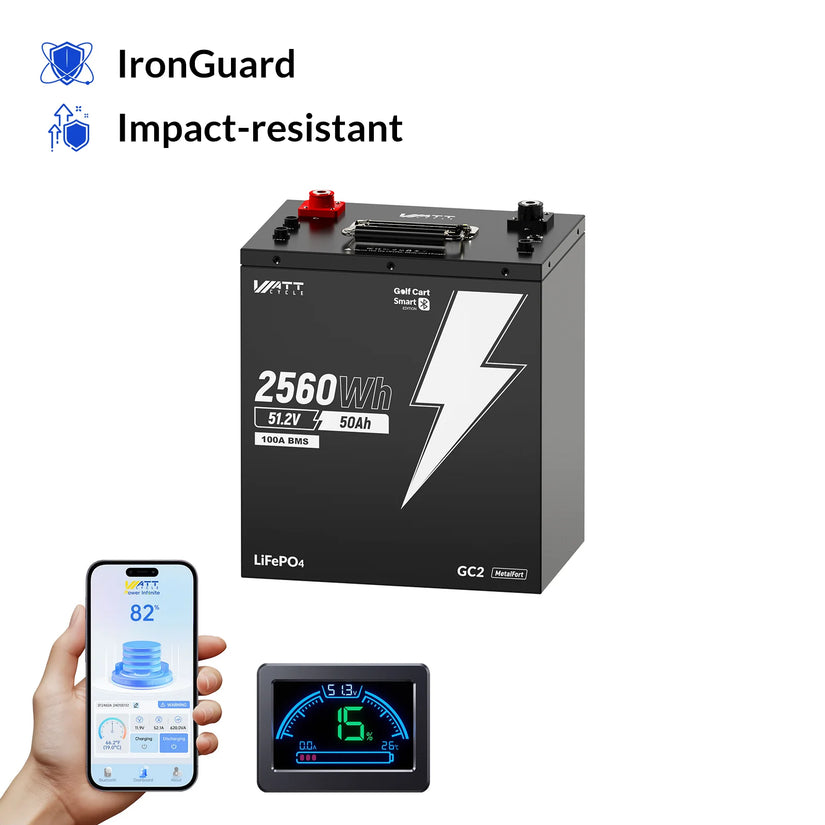
WattCycle 48V 50Ah GC2 Lithium Battery
The 48V 50Ah lithium battery runs $489.99. Use discount code BLOGEXTRA at checkout to get 6% off your order, after the coupon code only $460.59.
Can 48V 50Ah Handle Hills and Fast Acceleration?
Capacity is only half the story. The other half is how fast the battery can deliver power when the motor demands it, which is where a lot of "large enough" arguments actually live. The WattCycle 48V 50Ah GC2 LiFePO4 battery is built for a 2C continuous discharge rate, backed by a 100A BMS with peak over-current ratings of 150A for 30s and 300A for 0.5s. In practical terms, that headroom is what keeps a cart from bogging down when you punch the accelerator from a stop or climb a rise without losing speed halfway up. And if one 50Ah battery isn't quite enough for a heavier cart or a longer driving day, the battery supports up to 4 units wired in parallel, scaling up to 10,240Wh and well over 100 miles of range without switching to a different product.

Does 48V 50Ah Fit Your Golf Cart Without Modification?
Range and power aside, fit is often the first thing that makes buyers hesitate on lithium. Nobody wants to cut brackets or rewire a battery tray just to get a battery to sit right. The WattCycle 48V 50Ah GC2 lithium battery uses the standard BCI GC2 footprint at 10.4 by 7.2 by 13.02 inches and weighs 44 pounds, a fraction of what a bank of lead-acid batteries weighs in the same compartment. Because it matches the GC2 golf cart battery format used across the industry, it drops directly into carts from Club Car, E-Z-GO, Yamaha, Cushman, Star EV, Tomberlin, Icon EV, and Bintelli without modifying the battery bay. That kind of plug-and-play compatibility removes one of the biggest barriers people run into when they consider switching away from lead-acid.
How Long Does WattCycle 48V Lithium Golf Cart Battery Last?
This battery is rated for more than 6,000 deep cycles at 80% depth of discharge, which translates to a service life measured in years rather than seasons. A very low self-discharge rate ≤3%/month means the battery holds its charge through winter storage instead of quietly draining while the cart sits idle. A top-mounted physical ON/OFF switch lets owners cut power completely during long off-season stretches, preventing over-discharge damage that shortens battery life. Built-in temperature protection cuts off charging below 32°F and discharging below -4°F, and an IP54 waterproof rating combined with a metal shell protects the cells from vibration and moisture on rough turf. WattCycle backs the battery with a 5+2 years warranty and ongoing technical support, which matters more than most spec sheets once a battery is a few years into daily use.
Is 48V 50Ah the Right Choice for Your Golf Cart?
So, back to the original question: is 48V 50Ah large enough for a golf cart? For a standard single or two-passenger cart used for course play, resort transport, or neighborhood driving, the answer is yes. It isn't undersized for that use case, and it isn't overkill either, which is exactly why it works as a practical, well-priced option rather than a battery you're paying to grow into. If your routine runs longer than that, such as multiple rounds back to back or heavier daily use, the WattCycle 48V 105Ah golf cart battery is worth a look, with a 250A BMS and Bluetooth monitoring built in for extended mileage. But for most owners, the 50Ah version hits the balance of range, power delivery, drop-in fit, and long-term durability that makes it one of the more sensible picks among 48v lithium golf cart battery options on the market today, and for many, it's the best lithium golf cart battery for the job without paying for capacity they'll never use.

![[Free Monitor] Wattcycle 48V 105Ah Golf Cart Bluetooth LiFePO₄ Lithium Battery – 250A BMS for High Torque & Hills](http://www.wattcycle.com/cdn/shop/files/WT48V105AH250GCBT_fd49751b-10f0-467d-9543-afe48c8b6ec4.webp?v=1777023011&width=252)


Comments
No comments yet. Be the first to share your thoughts.
Leave a Comment