


![[Free Monitor] Wattcycle 48V 105Ah Golf Cart Bluetooth LiFePO₄ Lithium Battery – 250A BMS for High Torque & Hills](http://www.wattcycle.com/cdn/shop/files/WT48V105AH250GCBT_fd49751b-10f0-467d-9543-afe48c8b6ec4_300x.webp?v=1777023011)
![[Free Monitor] 48V 100Ah Golf Cart Bluetooth LiFePO₄ Lithium Battery - 200A BMS](http://www.wattcycle.com/cdn/shop/files/WT48V100AH200GC_300x.webp?v=1777023011)


![[Free Monitor] Wattcycle 48V 105Ah Golf Cart Bluetooth LiFePO₄ Lithium Battery – 250A BMS for High Torque & Hills](http://www.wattcycle.com/cdn/shop/files/WT48V105AH250GCBT_fd49751b-10f0-467d-9543-afe48c8b6ec4.webp?v=1777023011&width=320)
![[Free Monitor] 48V 100Ah Golf Cart Bluetooth LiFePO₄ Lithium Battery - 200A BMS](http://www.wattcycle.com/cdn/shop/files/WT48V100AH200GC.webp?v=1777023011&width=320)


If you own an EcoFlow Delta series power station, at some point you have probably looked at your setup and thought: I need more capacity. More runtime means more peace of mind during an outage, a longer off-grid stretch, or a solar storage system that can actually carry the load overnight.
The natural first step is the official EcoFlow expansion battery. Same brand, designed for your device, connects without any fuss. But once you look at the price per watt-hour, it is reasonable to wonder whether there is a smarter way to spend that money.
This article gives you an honest, side-by-side look at two approaches: the official EcoFlow extra battery versus a WattCycle 48V LiFePO4 battery connected via the WattLINK EF PPS Expansion Cable. No inflated claims in either direction. Just the facts you need to make the right call for your setup.
What Does an EcoFlow Expansion Battery Actually Do?
EcoFlow's Delta series is built around a portable power station (PPS) model. The base unit handles the inverter, display, and app connection. The expansion battery plugs into it and adds raw watt-hours to the system, extending how long you can run your devices before needing to recharge.
The expansion battery does not work on its own. It relies on the base station's inverter and communicates its state of charge (SOC) through the EcoFlow App. The result is a single, unified battery percentage visible from your phone.
How Does the Official EcoFlow Expansion Battery Stack Up on Paper?
The EcoFlow DELTA 2 Smart Extra Battery adds 1,024Wh of capacity to your Delta 2 at a retail price of $369.00. Combined with the Delta 2's built-in 1,024Wh, your total system capacity reaches approximately 2,048Wh.
At that price and capacity, you are paying roughly $0.36 per watt-hour.
The main selling point is integration. The expansion battery communicates natively with the EcoFlow App, so you get one unified SOC reading across the whole system. Setup is plug-and-play. There is nothing to configure and no separate accessories to source.
What Do You Actually Get With a Third-Party LiFePO4 Battery and a Compatible Cable?
This is where the comparison becomes worth paying attention to.
A WattCycle 48V 100Ah LiFePO4 rack battery holds 5,120Wh of capacity and is priced at $899.99. To connect it to a compatible EcoFlow Delta unit, you need the WattLINK EF PPS Expansion Cable (M8 to XT150), priced at $49.99. Together as a bundle, the total comes to $939.99.
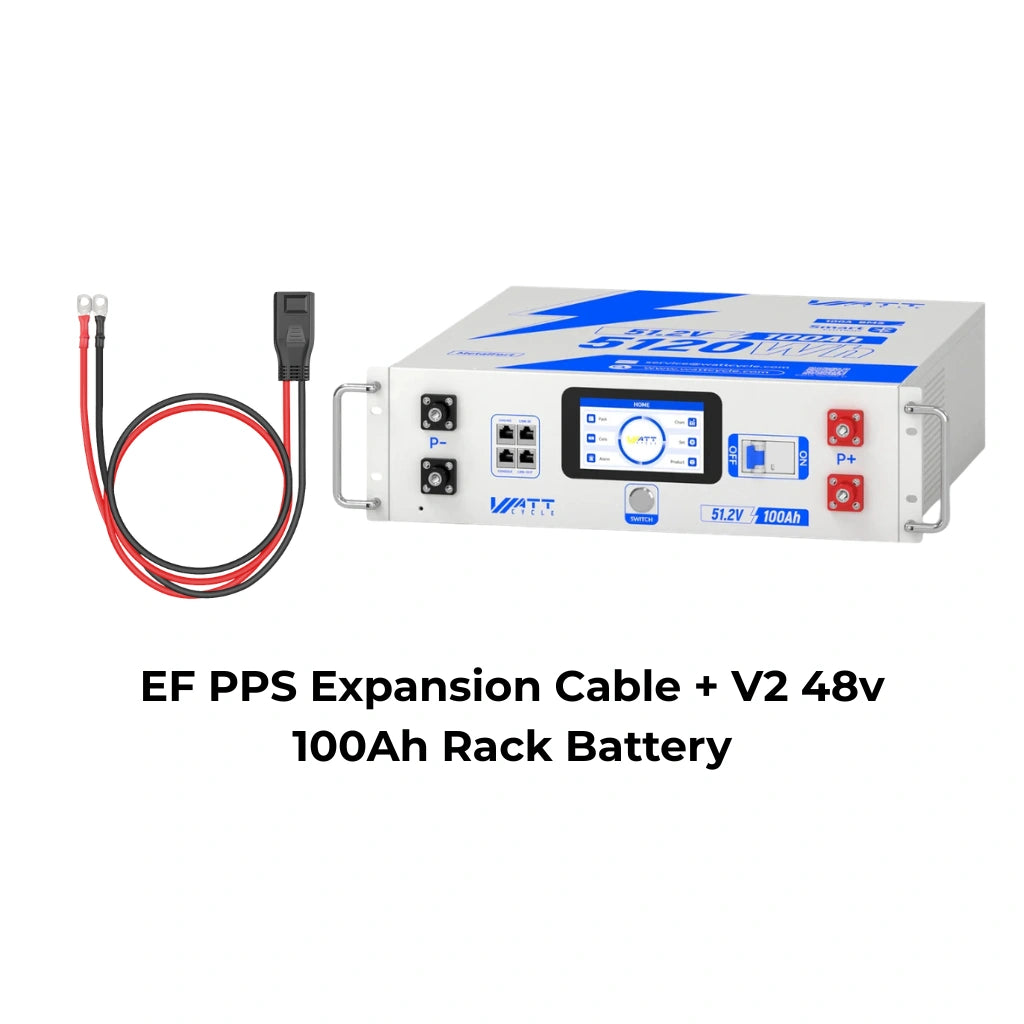
48V Sever Rack Battery + WattLINK Cable
That works out to roughly $0.17 per watt-hour on the bundle price — less than half the cost per watt-hour of the official EcoFlow option.
When paired with a Delta 2 (1,024Wh built-in), your total system capacity reaches approximately 6,144Wh. Pair it with a Delta 2 Max (2,048Wh built-in) and you are looking at roughly 7,168Wh. The WattLINK cable is also compatible with the Delta 3 and Delta 3 Plus.
One thing you should know before buying: when using a third-party expansion battery with your EcoFlow Delta, the app will display SOC for the Delta base unit and the WattCycle battery as two separate readings rather than one combined figure. Each unit tracks its own charge level independently. It is a minor adjustment to how you monitor your system, not a functional limitation, but it is worth knowing upfront so there are no surprises.
How Do the Two Options Compare Where It Counts?
Where Does the Official EcoFlow Battery Genuinely Have the Edge?
It is worth being straightforward here: the official EcoFlow expansion battery has real advantages, and glossing over them would not be doing you any favors.
Plug-and-play simplicity: You connect it and it works. No compatibility research, no setup beyond plugging in.
Unified app experience: If you monitor your system through the EcoFlow app, the official battery gives you one clean SOC percentage covering everything. For users who want a single number at a glance, that matters.
Single-brand support path: If something goes wrong with any part of your system, you are dealing with one company. That simplicity has real value, particularly for users who are not especially technical and just want everything to work together without thinking about it.
For buyers who want the most frictionless experience possible and are not pushing the limits of their capacity needs or budget, the official EcoFlow route is a reasonable choice.
Where Does a WattCycle Battery Paired With WattLINK Make More Sense?
The WattCycle approach has a clear advantage in one area, and it is a substantial one: you get five times the added capacity for roughly 2 times the price.
To put that in concrete terms: if you wanted to add 5,120Wh of expansion capacity using official EcoFlow extra batteries at $369 per 1,024Wh block, you would be spending close to $1,845. The WattCycle 48V 100Ah battery and WattLINK cable together come to $939.99. That is the same capacity at less than half the cost.
Beyond the price-to-capacity ratio, there are a few other practical reasons buyers lean toward this route:
No dependency on EcoFlow's product lineup: The WattCycle 48V 100Ah battery is a standalone product. It does not become redundant if EcoFlow updates its port design or discontinues a model. It can also be repurposed in other 48V solar storage or off-grid systems down the line.
LiFePO4 chemistry: The WattCycle battery uses lithium iron phosphate chemistry, which is well regarded for thermal stability and long service life. It is the same chemistry used in most serious home energy storage and solar applications.
Built for larger setups: If you are running a home backup system, an off-grid cabin, or a larger RV build around your EcoFlow Delta, 5,120Wh of added capacity changes what your system can actually do. A 1,024Wh add-on covers a gap. 5,120Wh changes the picture entirely.

Which Option Is Right for You?
There is no universal right answer here. It comes down to what your setup actually requires.
The official EcoFlow expansion battery is probably the better fit if:
- You want the simplest possible setup with zero additional configuration
- Unified SOC tracking in the EcoFlow app is a priority for you
- You are only looking to add a modest amount of capacity to cover a specific gap
- You prefer keeping your entire system under one brand with a straightforward support process
The WattCycle 48V 100Ah battery with WattLINK is likely the better fit if:
- Getting the most watt-hours for your budget is the main goal
- You are comfortable monitoring SOC across two separate readings
- You are building a more capable home backup, off-grid, or solar storage setup
- You already own a WattCycle 48V 100Ah battery and just need the WattLINK cable to connect it to your Delta unit.
The Honest Answer to a Fair Question
The official EcoFlow expansion battery is a well-made product that does exactly what it promises. If a clean, integrated experience with minimal setup is what you are after, it is a perfectly reasonable choice.
But if your priority is getting the most usable backup power for your budget, the numbers are pretty clear. The WattCycle 48V 100Ah LiFePO4 battery paired with the WattLINK expansion cable delivers five times the added capacity at roughly half the cost per watt-hour. For anyone building a serious backup setup around their EcoFlow Delta, that gap is difficult to overlook.
The WattLINK cable is available at $49.99. The WattCycle 48V 100Ah battery is $899.99, or $939.99 as a bundle with the cable included. After using the BLOGEXTRA discount code only $883.60 for this bundle.
[Explore the WattCycle 48V 100Ah + WattLINK Bundle →]
If you are attempting to build up your system but are unsure of how to proceed, please read this blog. It contains more detailed precautions that can help you identify the problem.
How to Expand Your EcoFlow Delta 2 Capacity Without Buying an Official Add-On


Comments
My life not working what could I burping wrong connected after both were 100 %
Leave a Comment