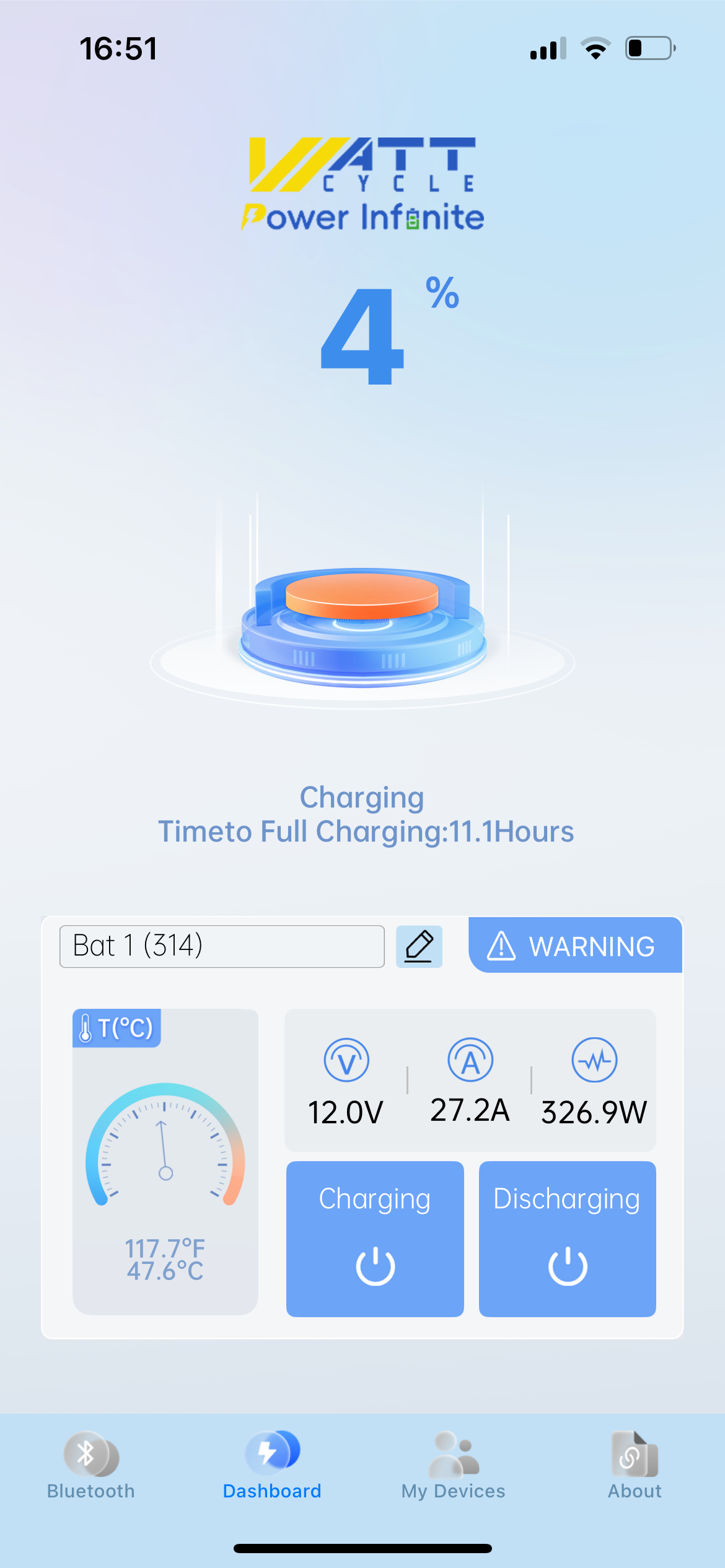
I am assisting a relative who has a Watt Cycle 100Ah battery, and it has blue-tooth and BMS. The battery charge state on the app was 92% and we used it to power an inverter, and over time it went down to 48%.
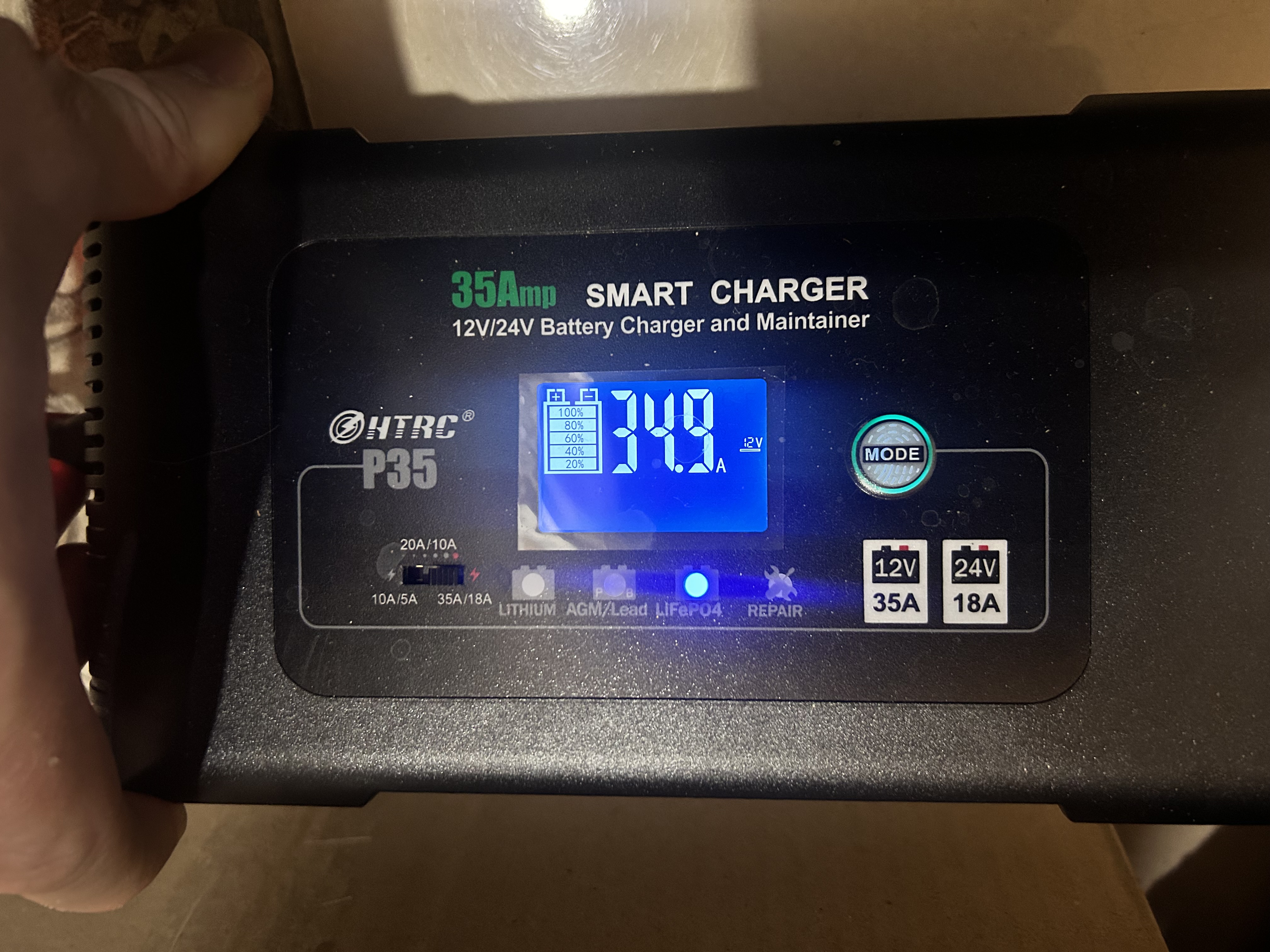
We wanted to recharge the battery using a LIFeO4 charger, and set it at 20A and it read 14.6 V on the charger display. After many hours the battery charge had not risen beyond 55% and looking on the app the charge rate was only 25 W !!. So is the BMS limiting it ?? If so why ?? Is there a away to use the battery charger to its proper 20 A rate ??
The battery charger screen shows 20A, 14.6 V., and the App battery readout sits around 25 W.
We tried the battery charger setting at 10A, 14.6V and also 5A, 14.6V - and the App says in put is around 25W.
What on earth is going on, and why is the BMS behaving this way. Do we need to buy ANOTHER different LiFeO4 compatible charger ?? If so, Why ??
Completely stuck, disappointed, and desperate (and very grateful) for any assistance.
Many thanks
@Tim-peter I doubt the BMS is limiting the charge. Usually a bms will allow charging and then turn it off when at least one cell of the battery is at the maximum safe level. But it is an on/off switch, not a dial that can slow down charging. Are there any adjustments you can make on the charger? Can you test the charger on another battery? Otherwise the only option would be to try another charger.
Thanks for the response. The Wattcycle App is clearly showing that the battery is being charged at around 25W. It goes to zero when charger turned off. Returns to around 25W when charger turned on. Its set at 14.6V and can change current to 5A 10A and 20A and its consistent at 25W, which means charging will take forever. Charger works fine on other batteries but not the Wattccyle one with the BMS. Charging on solar the battery charges at 150 W and above from the solar set up. So its definitely the interaction with the Battery (and I guess BMS) and the charger - which is marketed as a LiFeo4 charger. I am beginning to think the BMS is way more trouble than its worth if it cannot take the range of chargers on the market. I guess we just try random chargers from Amazon and hope one is accepted by the BMS. Appreciate the feedback.
Якось стікнувся з таким, як потім вияснив, в моєму випадку була знижена температура і обмежувався струм заряду. І у вас обмеження по Ватах чи Амперах?
I have the same problem, the battery is drawing too little current. Can anyone comment? Suggest a solution?
> "...bms more trouble..." I assume you know that the lithium batts REQUIRE a bms to work properly and safely? Not all have bluetooth - maybe you mean the bluetooth is causing the trouble? In my experience, charger labels, ratings, etc refer to the maximum the unit might deliver in one exact situation. The actual behavior in general varies based on how long the charger has been attached (usually controlled by the charger's programming), SOC, temperature (both batt and charger), connection quality... If there are permanent loads attached to battery that the charger must also supply, that will affect the charge rate as well. Also in my experience, most electronics sold on ebay and amazon, allibaba and similar, cannot be expected to work to spec until you have personally verified their behavior in your situation; then there is no way of knowing how long lasting or consistent that behavior will turn out to be. Confidence in what you get when buying stuff will to cost you time (research) and money (brands and sellers) - or your personal time/expense/pain to test it and try. In this case, I'd first check any charge curves showing voltage and amps, against time, that Wattcycle has published for the batt you have, to see what is actually expected (spec'd) - for that battery. Then check voltage at the battery with a known accurate meter to see if the charger is lying. Then check the delivered amps if you have or can get a clip meter; or do amps first if you have a clip meter - most people don't. But w/out checking the curves you don't _really_ know what actually should be happening over the charging cycle. Best luck.