
Battery management. How the BMS works?


  •  

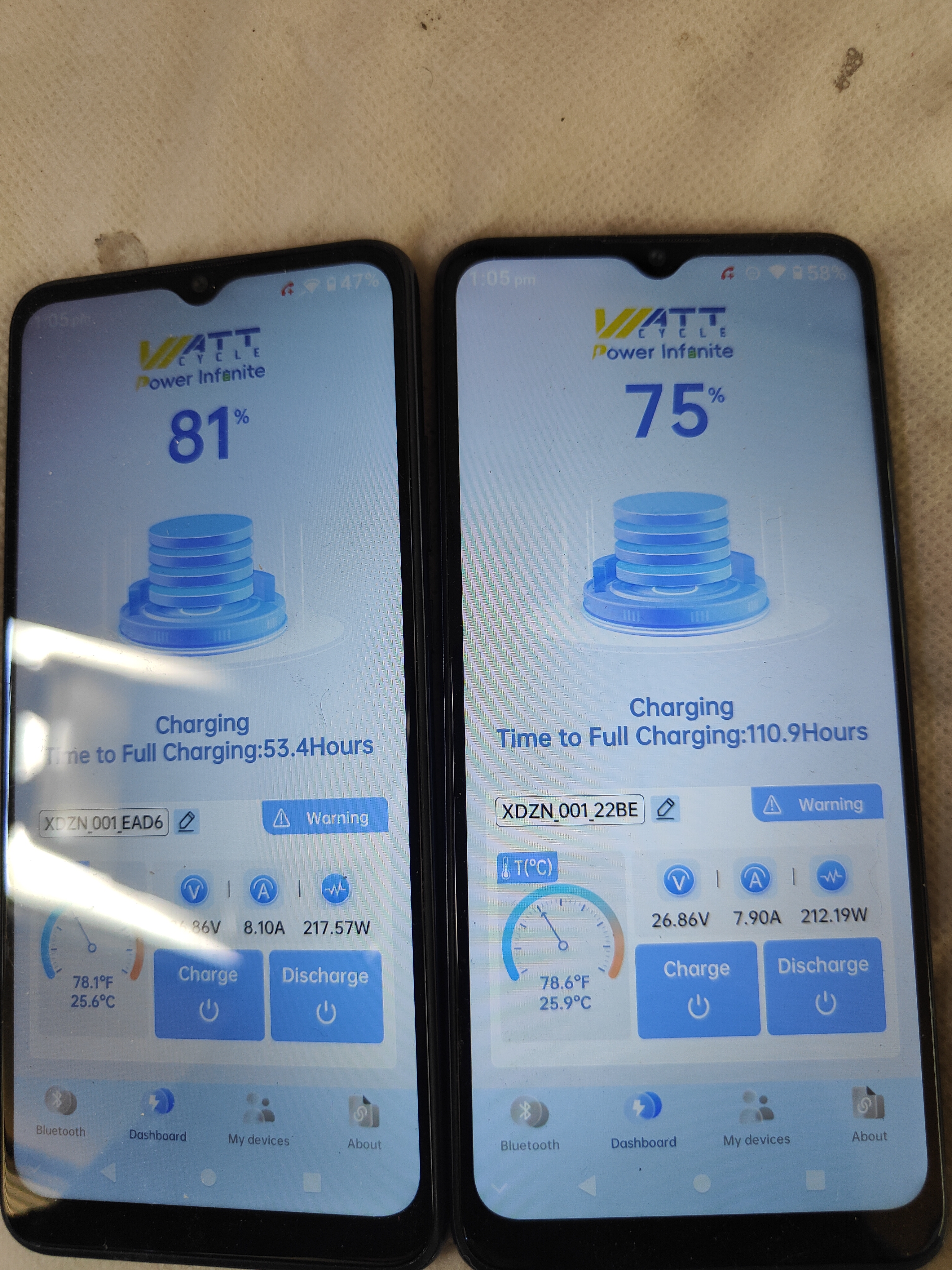
    I have a question about how the BMS knows (or works out) how much charge is in the battery, and how much it should be able to hold. My shunt/monitor does not track very closely to what the batteries report (well, close, but no cigar). The reason I ask is that the batteries are identical but clearly have a different idea about their capacity and state of charge. Looking at the picture, we see B1 at 81% (at 26.86v) and stating 53.4 hours till full. And B2 at 75% (at 26.86v) and stating 110.9 till full (taking in the same ampage). They appear to have very different ideas about how much they can hold. And as they go up and down over the weeks, they appear to change their idea of which can hold more. I've got some idea of what's happening here but I wanted to ask for other people's thoughts and interpretation of these behaviours.

    Also, do they need to cycle from 0 to 100 to get a good idea of their capacity, and how many times?

    Any thoughts, anyone?

    Cheers.


  • Pete 

    I have 16 Aims LiFePo Bluetooth BMS , connected 4s4p with 2  liTime balancers.  These are not new. None agree on remaining capacity, but I can read individual cell voltage. Some battery cells are balanced, some are not.

    I try to charge the bank to maximum so the weak cells don't cripple the stronger ones.

    I look for balancer connection issues if the cells get too far apart.

    I think the BMS capacity numbers don't match because the processor is trying to measure voltage on a very flat curve. 

    Perhaps a more precise measurement would be to measure watts in / out on a totalizing register. One would have to calibrate on occasion from minimum to maximum charge to have confidence in the capacity report.

    If you dig into the white papers for LiFePo battery technology, the battery is not fully charged until it no longer accepts current. The voltage, when current rejection occurs varies with conditions, temperature, charge rate, wiring integrity, battery age, condition, ...  ...

    If you continue to charge LiFePo past current rejection, the battery can be damaged. If you charge to a safe voltage, it's unlikely the cells will balance and establish a 'memory.'

    There may be a manufacturer with a BMS that measures watt-hours, post the name if you find any.

    Also, maybe someone's doing charge control on current rejection. Would like to know if any out there.


  • @Louis Ash . Thank you, Louis. More food for thought.


  • @peterp Do you have parallel mode enabled? The manual states that it can result in this behaviour. 

    I have not installed mine yet, so I don't have any direct experience. 


  • Thanks, @Shawn Wright yes, the parallel mode is enabled, but the batteries behave this way without it enabled anyway. They are improving as I cycle them up and down but I would like to get a better idea of how they (the bms's) work.


  • Pretty sure that most BMS's measure watt-hours (Wh) by calculation, not by direct measurement, usually using a "shunt", to monitor voltage and current over time. 

    I suspect that WattCycle is using TDK BMS's and "modifying" them, their mod's causing most all their issues.

    Can anyone confirm the manufacturer of the WC bms's.  It may help resolve 90% of our issues.  WC won't tell me.


Please login to reply this topic!